


Video - The Covenant Hearth: A Practical Guide to Rediscovering the Forgotten Tools and Rhythms of Family Worship
Introduction
“You will make known to me the path of life; in Your presence is fullness of joy; in Your right hand there are pleasures forever” (Psalm 16:11)
Back when I was a boy, I tore through the streets of Helena, Montana, on my Schwinn bike—banana seat gleaming, streamers whipping in the wind—my world a map of wonders. There was the little Christian school my folks founded and then poured their hearts into, the little frosty freeze drive in where my fun-loving Mom and Grandma flipped burgers and goofed around together all day long, Dad’s office up at the state capital, Aunt Bonnie’s bookstore stuffed with adventures, and the park where my brother and I chased summer evenings playing tag. That town was our kingdom, every corner alive with possibility. Tuesdays meant wrestling with my violin, Wednesdays were for the church’s Cadets scouting group, Saturdays found me galloping on my pony Amber. Sundays? We’d fill the pews of the church Grandpa built, his voice gentle yet full of power from the pulpit, Mom’s organ lifting our hymns, and me sneaking notes under the pew to Kari, the other pastor’s pretty blond daughter. Oh, and don’t ever forget Grandma’s flannel-board Bible stories lighting up our Sunday school imaginations. Never forget that.
Life had a rhythm then, steady as a heartbeat—school, play, worship, all woven tight. No internet, no screens stealing our gaze. Strangers tipped their hats with a “Hello!” like old friends. The librarian, the policeman—they were kin, part of the warm circle of our town. Neighbors weren’t just faces; they were companions, sharing porches, prayers, and laughter.
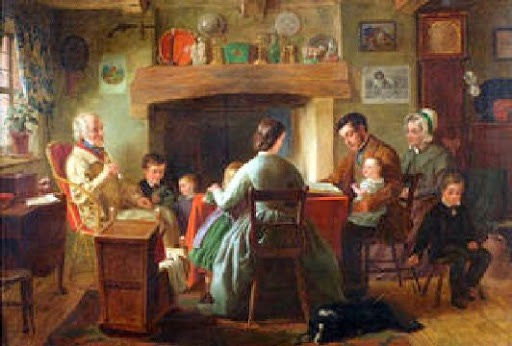
Technology has changed so much. 100 years before my time, the home was a hearth, glowing with evenings spent reading Mark Twain or Jane Austen aloud, voices mingling in joy and tears. Then came the radio’s hum, pulling families close together for stories; 20 years later, the TV’s flicker became common, and families still gathered as one. But now? Screens sprout in every room, each soul tethered to its own glowing idol. Smartphones bind us to a world beyond, yet leave us stranded, alone in our own homes.
Once, the home was a castle, its doors a portcullis against the world’s clamor, a sanctuary for sacred rites—suppers savored, prayers offered, hearts knit in love’s quiet fidelity. Now the world storms in. Phones buzz and chirp, shattering the stillness of a meal, a story, a prayer. Friends and strangers alike barge into our holiest moments, their digital din drowning the whisper of kinship. Is this progress? I wonder, the question heavy as a stone. When do we linger to talk, to listen, to know one another? Where is the porch, that sacred threshold where neighbors traded tales under a star-strewn sky? Where is the fellowship of a street alive with voices? In a century, we’ve traded the sandlot’s dusty joy for the cold hum of screens, the cathode’s glow eclipsing the light of human nearness.
The sacred hearth that was home is all but gone.
Are we richer? In one way, sure— the child’s BMX has been exchanged for the stockbroker’s BMW, and Aunt Bonnie’s bookstore has given way to a towering office of glass. Our gadgets would’ve left Grandpa speechless. But richer in life? I’m not convinced. Our machines dazzle, miracles of wire and code, but their price cuts deep. We’ve lost the world of flesh and voice, of neighbor and kin, of time unhurried and space unbroken. Call me nostalgic, a fool chasing shadows; I’ll bear the name. Prosperity, we’re told, is the measure of man’s climb. But what if it’s not? What if, in grasping these wonders, we’ve let slip the true world—the one where families sang hymns around Mom’s piano or crowded Grandma’s table for Sunday dinner on the good china, laughter from board games filling the air?
Even the church, meant to shine as a city on a hill, has wandered. Little parishes, where we worshipped as one, have yielded to megachurches with jumbotrons and fog machines, or to screens where folks “attend” an online Cathedral of One. Pastors chase likes, not souls, trading shepherding for spectacle. Churches drown in programs, programs, and more prgorams.
The sacred hearth that was church is also all but gone.
Actually, I believe that this is the main reason that the home hearth has lost its fire. As the Church goes, so goes the home. In our homes, we used to pray together, read Scripture, talk about God over supper. Now, it’s a scramble to gather the American Family, screens pulling us apart. But hope stirs. This book is a call to rekindle that hearth, to return to the old ways—praying daily, singing psalms, catechizing children. It’s simple, like those Montana summers, but it’s holy, a household altar where faith takes root. These rhythms echo the church’s life in Christ, the Host who draws us to His table, binding us to one another and to Him.
So, come back, friends, to the warmth of that hearth. Let’s light the fire again, by returning to these old paths where families and churches are renewed in the presence of the One who makes all things new.
In the link below you will find a set of study questions for Genesis. I will be adding to them regularly.
What you will want to do is sit down with your family, maybe sing a hymn, have a prayer where you ask the Holy Spirit to guide you study and illuminate your mind, and then read one Chapter of Genesis.
Then what I am providing you here to help guide your study is 4 levels of questions:
Which will give your family a clear, four-tier progression: start with easy facts to make sure everyone understands the story, then move deeper into meaning, application, and theology.
These questions aim to make Genesis a foundation for your family to understand God’s redemptive plan, their connection to Jesus, and to encourage each member towards personal and theological reflection on our God
If you faithfully study God’s word, he will stretch you towards deeper insights and a more meaty and advanced knowledge of him.
So welcome back to the warmth of the Covenant Hearth as our God brings us all together further up and further in.
First Set of Study Questions for Every Chapter of Genesis
Genesis 1: God Creates the World
Factual Recall
What did God say on the first day?
What did God make on the second day?
What did God call the light part and the dark part?
On which day did God make the sun, moon, and stars?
What did God make on the sixth day?
What did God say about everything He made at the end?
On which day did God rest?
Simplified (Beginner)How does God’s creation of the world show His power and love? What does it mean that humans are made in God’s “image” (v. 26–27)? How does Jesus, who is the perfect image of God (Colossians 1:15), show us how to live as God’s people?
Intermediate
How does the repeated phrase “and God saw that it was good” (e.g., v. 10, 12) show God’s delight in His creation? What does this teach us about finding joy in God’s work?
Why does God create light first (v. 3) before the sun and stars (v. 16)? How does this order show His authority over creation?
Advanced
Genesis 1 structures creation like a temple-building process, culminating in God’s rest. How does this prefigure the church as God’s temple in Christ (Ephesians 2:21–22)?
The “image of God” (v. 26) implies humanity’s royal and priestly role. How does Christ, as the true image (Colossians 1:15), fulfill these roles, and what does this mean for the church’s mission in the new creation?
Genesis 2: The Garden and God’s Rest
Factual Recall
What did God finish on the seventh day?
Where did God put the man He made?
What two special trees were in the middle of the garden?
What job did God give the man in the garden?
What did God say was not good?
What did God make from the man’s side?
What did the man call the woman?
SimplifiedWhy does God rest on the seventh day, and what does this teach us about trusting Him? How is the garden like a special place to meet God? How does Jesus invite us to find “rest” in Him (Matthew 11:28)?
Intermediate
Why does God place Adam in the garden to “work it and keep it” (v. 15)? How does this show our purpose to care for God’s world?
How does the creation of Eve as a “helper” (v. 18) show God’s design for relationships? What does this teach about love and unity?
Advanced
The garden is a sanctuary where God walks with humanity (v. 8). How does this prefigure the tabernacle and Christ’s incarnation as God “dwelling” among us (John 1:14)?
The Sabbath rest (v. 2–3) points to eschatological fulfillment. How does Hebrews 4:9–11 connect this rest to Christ’s work, and what does this imply for the rhythm of Christian life?
Genesis 3: The Fall into Sin
Factual Recall
Who talked to the woman in the garden?
What did the serpent say would happen if they ate the fruit?
What did the woman do with the fruit?
What did Adam do after the woman gave him the fruit?
What did God ask Adam and the woman?
What did God say would happen to the serpent?
What did God make for Adam and Eve before they left the garden?
SimplifiedHow do Adam and Eve’s choices break their friendship with God and each other? God promises a “seed” to defeat the serpent (v. 15). How does this point to Jesus winning over sin? What hope does this give you today?
Intermediate
Why does the serpent target Eve with his question (v. 1)? How does his twisting of God’s words show the nature of temptation?
How do the curses (v. 14–19) affect relationships (God-human, human-human, human-creation)? How do you see these effects in the world today?
Advanced
The “seed of the woman” (v. 15) is the first gospel promise (protoevangelium). How does this theme of conflict between seeds unfold through Genesis and culminate in Christ’s victory (Galatians 3:16)?
Adam and Eve’s attempt to cover their shame (v. 7) contrasts with God’s provision of skins (v. 21). How does this foreshadow the sacrificial system and Christ’s atonement as the true covering for sin?
Genesis 4: Cain and Abel
Factual Recall
Who were Adam and Eve’s first two sons?
What job did Cain have?
What job did Abel have?
Which offering did God like?
What did Cain do to his brother Abel?
What did God put on Cain so no one would kill him?
What did Cain build after that?
SimplifiedWhy does God accept Abel’s offering but not Cain’s (v. 4–5)? What does this teach about giving God our best? How does Jesus’ sacrifice cover our sins better than Abel’s offering (Hebrews 12:24)?
Intermediate
Why does Cain’s anger lead to murder (v. 8)? What does this show about how sin grows in our hearts?
God marks Cain to protect him (v. 15). How does this show God’s mercy even to sinners?
Advanced
Abel’s blood “cries out” (v. 10), but Hebrews 12:24 says Jesus’ blood speaks better. How does this contrast reveal the progression from Abel’s sacrifice to Christ’s ultimate atonement?
Cain builds a city (v. 17), contrasting with God’s garden. How does this reflect competing visions of human community, and how does Christ’s kingdom resolve this tension?



Comments